
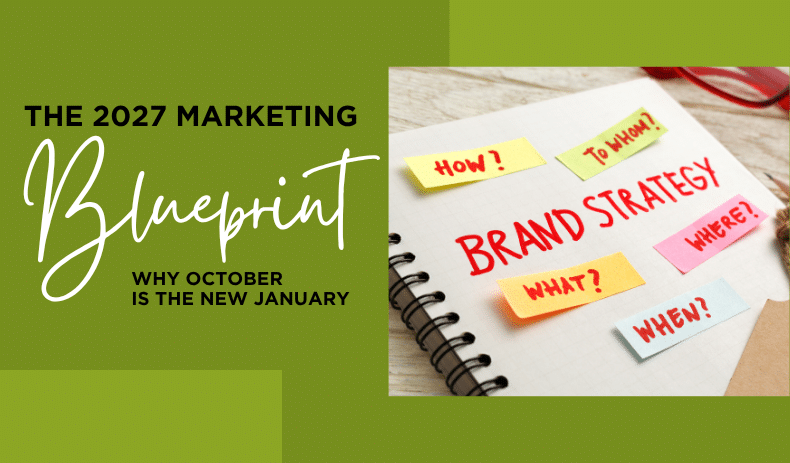
If you are waiting until January to plan your 2027 marketing strategy and budget, you may already be behind.
For years, businesses treated January as the time for fresh starts and clean slates. But in today’s fast-paced digital landscape, Q1 isn’t the starting line, it’s where the race is already won or lost. Rolling into the New Year without a finalized strategy means spending all of January planning, February organizing, and March scrambling to launch. By then, a quarter of the year is gone.
Treating October as the new January gives your business the runway it needs to hit the ground running on day one. Here is why early planning is critical, along with a four-step blueprint to lock in your strategy now.
Why January is Too Late for Your 2027 Budget
- Ad Costs Skyrocket in Q4: The holiday season brings peak ad competition. If you wait until January to figure out your audience targeting, messaging, and ad spend, you miss out on gathering historical data and optimizing your campaigns before the post-holiday reset.
- Lead Times Require a Runway: From website updates and high-converting landing pages to complex content calendars, quality marketing assets take weeks to strategize, build, and approve.
- The “Great Saturation” Demands Intentionality: With the internet flooded with automated content, cutting through the noise requires deep, data-backed strategies. Rushed planning in January results in generic campaigns that fail to break through.
Your 4-Step Blueprint to Lock in Strategy Now

1. Audit Your Current Data
- Analyze Q1–Q3 Performance: Pull metrics for your website traffic, organic rankings, and paid ad campaigns to see exactly where your leads came from this year.
- Identify High-Value Assets: Look for the specific blog posts, case studies, or social media campaigns that drove real business growth, and note what fell flat.
- Review Customer Touchpoints: Evaluate where customers drop off in your funnel so you know what needs fixing before launching new campaigns.

2. Align Budgets with Concrete Goals
- Define Revenue Goals: Establish clear revenue targets for 2027 before allocating a single dollar to specific marketing channels.
- Set Core KPIs: Decide on the top three to five key performance indicators (like cost per acquisition, organic lead volume, or customer lifetime value) that will define success.
- Calculate Customer Acquisition Cost (CAC): Use your current CAC to reverse-engineer exactly how much budget is required to hit your new growth targets.
3. Prioritize Authenticity and Human Connection
- Plan Content Around Real Experiences: Shift your strategy away from generic, over-polished content and focus on unique insights, case studies, and behind-the-scenes perspectives that algorithms and audiences favor.
- Map Out High-Touch Elements: Incorporate personalized video notes, community forums, or human-led touchpoints into your workflow to build deeper trust with your audience.
- Balance Automation with Empathy: Use efficient tools to handle repetitive scheduling, workflow management, and analytics, but keep human oversight at the center of your creative messaging.

4. Build Your Execution Roadmap
- Create a Q1 Content Calendar: Outline your core topics, campaign themes, and visual asset needs for the first three months of the year.
- Assign Team Roles: Clearly define who is responsible for writing copy, designing graphics, monitoring analytics, and managing ad spend.
- Establish a Launch Timeline: Set firm deadlines throughout November and December to ensure all foundational assets, tracking links, and landing pages are live before January 1.
Take the Lead on 2027
Planning early takes the stress out of the holidays and ensures your business enters the new year with clarity, purpose, and a distinct competitive edge.
Let us know how The Stone Group can assist you in your 2027 marketing strategies and budgets.
Recent Comments